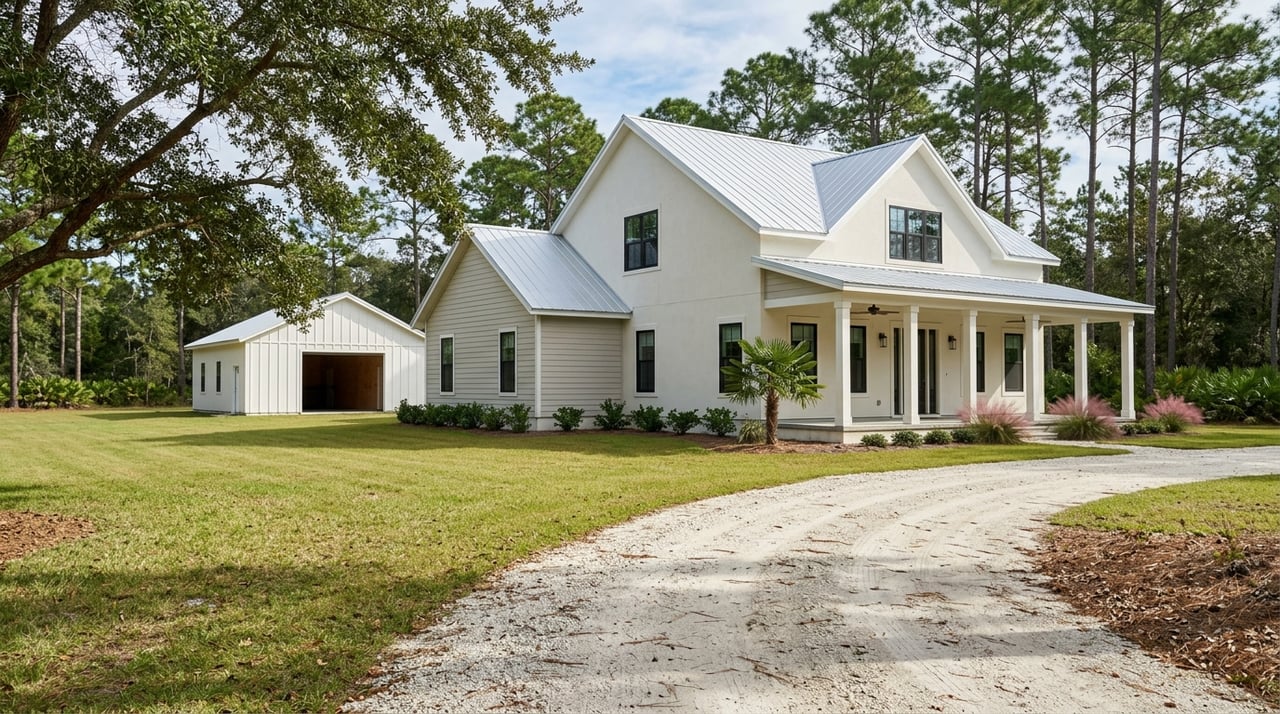
Guide to Buying Cantonment FL Acreage and Rural Homes
April 16, 2026
April 16, 2026
If you are thinking about buying acreage or a rural home in Cantonment, it helps to know this market works a little differently than a typical subdivision. A larger parcel can offer privacy, room for hobbies, and space for outbuildings, but it can also come with more moving parts during your home search. When you understand zoning, utilities, permits, and storm-related risks before you buy, you can make a more confident decision. Let’s dive in.
Cantonment sits in a suburban-to-rural transition area in Escambia County. According to Escambia County’s overview of the Cantonment Redevelopment District, the area includes low-density residential, commercial, and agricultural uses and serves as a gateway to more rural parts of northern Escambia County.
That local setting is a big reason buyers look here for land-rich properties. If you want more elbow room, a detached workshop, or a property with agricultural potential, Cantonment can offer options that are very different from in-town homes closer to Pensacola.
Before you shop for acreage, it helps to understand the broader market. As of March 31, 2026, Zillow’s local home value data shows Cantonment’s average home value at $326,084, with homes going pending in about 43 days.
That same data shows Pace at $322,546 with about 36 days to pending, while Pensacola sits lower at $261,306 with about 45 days to pending. These numbers are useful for general context, but they are not acreage-specific comps.
That distinction matters. Rural and acreage homes in Cantonment do not always track subdivision pricing in a simple way, because land size, utility setup, zoning, and legal improvements can affect value much more than the citywide average.
When you buy a rural property, you are not just buying a house. You are often buying a mix of land use rights, utility conditions, access features, and structures that can vary widely from one parcel to the next.
For example, two homes with similar square footage may have very different value if one has verified zoning for your intended use, a permitted barn, and well and septic systems in solid condition. Another may look similar online but require updates, permit work, or extra due diligence after closing.
That is why the best comparable sales for acreage properties are often other acreage properties with similar utility and zoning characteristics, not just nearby homes in traditional neighborhoods.
One of the most important steps in buying acreage in Cantonment is verifying the exact zoning for the specific parcel. Escambia County Planning and Zoning says staff need both the property address and the 16-digit property reference number to confirm zoning and future land use.
In other words, do not assume a parcel allows what you want just because of the street, area, or nearby properties. Parcel-specific verification should come first.
Escambia County’s land development code says the Agricultural (AG) district is intended for low-intensity rural land such as farmland, open space, woodlands, and fields. The code notes that AG zoning is not meant for areas with central sewer or highly developed street networks.
In AG zoning, the density limit is one dwelling per 20 acres. The code also states that agricultural uses can include livestock, nursery plants, and stables on lots 2 acres or larger.
If you are looking at horse property, pasture, or land with agricultural use in mind, this is one of the first details to review with care.
The county’s Rural Residential (RR) district is designed for low-density rural living with limited urban infrastructure. Detached single-family homes are generally allowed on lots 4 acres or larger, or on 1-acre lots if clustered to help preserve prime farmland.
This is often the kind of zoning buyers may encounter in more rural parts of the Cantonment area. Even so, the only safe approach is to verify the exact parcel before you move forward.
If your goal is a horse-friendly property, the details matter. Escambia County’s code says that in the Low Density Residential (LDR) district, horses or other domesticated equines kept as a private residential accessory require at least 2 acres, with no more than one animal per acre.
The code also says horse shelters must be at least 50 feet from any property line and 130 feet from a neighboring dwelling. If you want a barn, stable, or turnout area, it is smart to confirm those standards before closing, not after.
If you are buying pasture, horse property, or land with agricultural use, ask early about tax treatment. The Escambia County Property Appraiser says agricultural classification applies only to land used primarily for bona fide agricultural purposes, and applications are due by March 1.
This does not mean every acreage property will qualify. It does mean classification is worth discussing during your due diligence, because it can affect carrying costs and your long-term ownership plans.
For many rural buyers, wells and septic systems are some of the biggest inspection items. Beginning January 2, 2025, septic system permitting in Escambia County is handled by the Florida Department of Environmental Protection rather than the county health department.
That makes it especially important to review septic permit history, tank age, drainfield location, and any known repairs. On acreage properties, system placement can also affect where you may want future improvements.
Private wells deserve just as much attention. The Florida Department of Health does not require well sampling for private homes at the time of sale, but it strongly recommends annual testing for bacteria and nitrate, plus lead testing every three years for most homeowners.
The same guidance notes that Escambia County’s Water Quality Laboratory can test private potable wells for bacteria for $30 per sample. If a home relies on a private well, testing and reviewing past maintenance should be part of your purchase plan.
Acreage buyers often picture a barn, shed, workshop, or extra storage. That can be a great fit for rural living, but you should verify what is legal and what needs permits.
According to Escambia County permitting guidance, any utility or storage shed with a poured slab or posts installed into the earth needs a building permit, no matter the size. A portable skid-mounted shed under 120 square feet does not.
The county’s land development code also places size limits on accessory structures for single-family lots unless the structure is on a farm or within agricultural zoning. On lots under 2 acres, no accessory structure may exceed 50% of the principal dwelling’s gross floor area. On 2 to 5 acres, the limit is 75%. On lots over 5 acres, an accessory structure may not exceed the size of the principal dwelling unless a variance is approved.
If you are planning a barn or stable, the zoning details matter too. In AG zoning, stables and private or public stables are allowed on lots 2 acres or larger. That is another reason to verify the parcel and your intended use together.
In Northwest Florida, storm planning is part of smart homebuying. Escambia County participates in the National Flood Insurance Program and provides floodplain and flood map resources, with current flood-hazard maps effective August 19, 2025.
The county also advises owners to check their evacuation zone each year, since evacuation zones can change. For acreage properties, this is especially important because long driveways, low-lying areas, drainage features, and detached structures can create risk that is not obvious in listing photos.
FEMA notes that flood insurance is available even outside high-risk flood zones and that most homeowners insurance does not cover flood damage. That is an important point for rural buyers who may assume a larger parcel automatically means lower flood exposure.
Wind exposure matters too. The Florida Department of Financial Services says some homeowners policies do not cover windstorm damage such as hurricanes, and Citizens notes that wind-mitigation features like shutters or impact-resistant openings may help a home withstand severe weather and may qualify for premium discounts.
As you evaluate a property, ask about roof age, opening protection, and any documented wind-mitigation features. On rural homes, insurance costs can be part of the affordability picture just as much as the sale price.
Flood risk is not just about whether a property needs insurance today. Escambia County’s flood-repair guidance says that if a structure is substantially damaged or substantially improved, it may need to be brought into compliance with floodplain rules, including elevation to or above the 100-year flood elevation.
That can become a major cost factor on some properties. If a parcel has older improvements, detached buildings, or low-lying areas, this is worth reviewing during your inspection and due diligence period.
If you are shopping for acreage or a rural home in Cantonment, keep this checklist handy:
Buying acreage in Cantonment can open the door to a very different lifestyle than a standard neighborhood home. You may gain more land, more flexibility, and more privacy, but you also need a more detailed review of zoning, utilities, structures, and risk factors.
The good news is that with the right guidance, you can sort through those details before they become surprises. If you want help evaluating acreage, rural homes, or land-rich properties in Cantonment and the greater Pensacola area, connect with William Maybin for local, hands-on guidance tailored to your goals.

Whether you're searching for your dream home, looking to sell, or seeking valuable advice, I'm here to guide you through every step. Let's turn your real estate dreams into reality!